Your Business Gets a Verified Yes. We Keep the Liability.
Hypersign handles customer identity verification and consent. Your systems only ever see the result.
The Flow
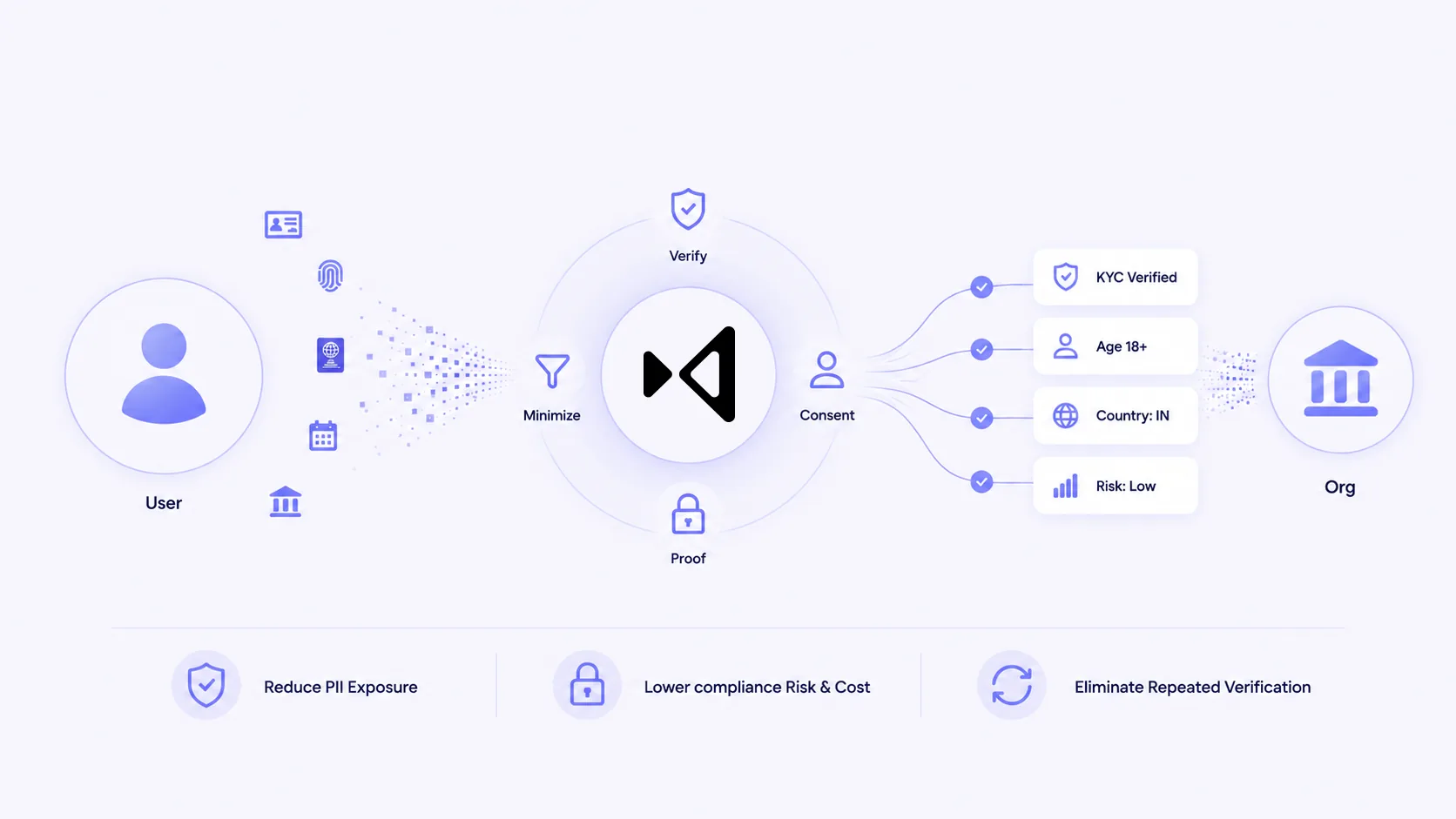
Raw identity data never has to reach you.
Customer identity verification — or identity proofing — happens with Hypersign. Your business receives a verified result and audit reference, never the underlying document, biometric, or PII.
- Purpose-specific consent captured before anything is checked
- Documents and biometrics held in an encrypted vault, never on your servers
- Every step logged to an immutable audit trail
What Changes For You
Less to store. Less to defend. Less to prove.
0
PII Fields Stored On Your Servers
1
Platform, Not 4–7 Vendors
100%
Consent & Verification Events Logged
<2s
Verified Response Time (p99)
The Difference
Same KYC onboarding. Very different liability.
Without Hypersign
- Raw ID scans and biometric files sit on your servers indefinitely
- Your company is the breach-notification party if any point vendor is compromised
- Consent tracked manually, or not at all, per tool
- Retention and deletion handled ad hoc, tool by tool, audit by audit
With Hypersign
- Documents and biometrics never reach your infrastructure
- Hypersign's encrypted vault carries the custodial and storage risk
- One purpose-specific consent record, revocable in a single place
- Auto-purge retention windows with a signed erasure certificate
What Makes Hypersign Different
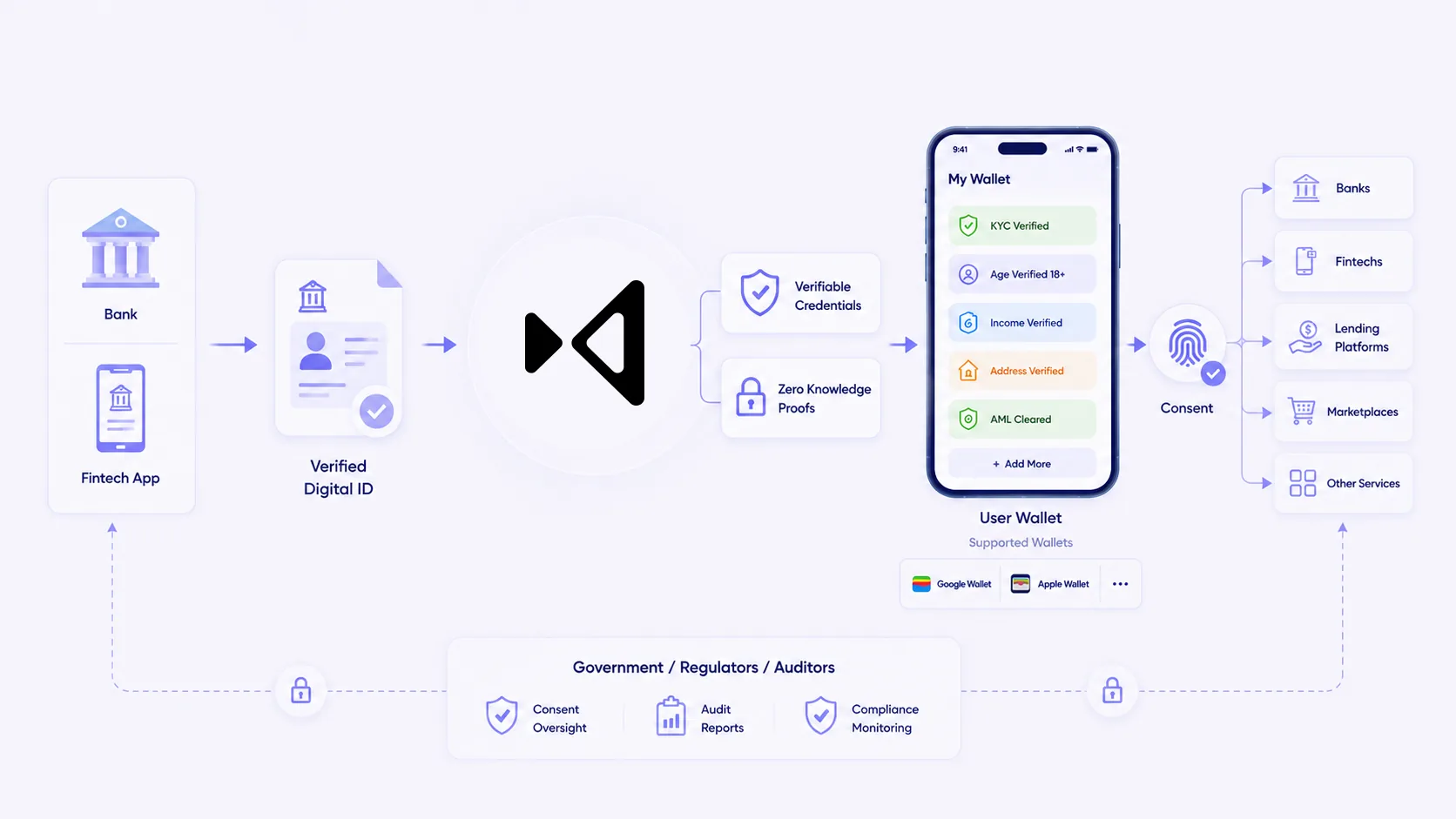
Verify once, reuse everywhere with verifiable credentials.
Most digital identity verification vendors solve one part of the problem. Hypersign runs identity, consent, and reusable credentials as one platform.
- One platform, not four vendors stitched together
- A portable credential your customer's next bank or fintech can trust instantly
- Age verification without ever collecting a birthdate — privacy that's structural, not a policy
Built On First Principles
Privacy-by-design for identity verification.
Collect less. Expose less. Defend less.
Hypersign builds data minimization, purpose-specific consent, and auditability into every identity proofing and KYC onboarding workflow. Two examples of how that plays out:
Use Case
NBFC & Lending Onboarding
An NBFC's Account Aggregator license covers bank-statement and GST consent — not the PAN, Aadhaar, and biometric checks running in the same session. That gap sits with whichever KYC vendor is plugged in.
- Consent → a revocable toggle before any check runs DPDP §5, §6(1)
- Selective disclosure → a pass/fail result, not the raw document DPDP §6(1)
- Vault retention → auto-purge with a signed erasure certificate DPDP §8(7)–(8)
- Audit trail → a signed record producible to the Data Protection Board DPDP §11–13
Use Case
EU Fintech & Payments Onboarding
GDPR's data-minimization principle and AMLD6's multi-year document-retention mandate pull in opposite directions — an EU fintech has to satisfy both inside the same onboarding flow, not choose one.
- Consent → purpose-specific, granular consent before any check runs GDPR Art. 6(1)(a), 7
- Selective disclosure → verifier gets a pass/fail claim, not the document GDPR Art. 5(1)(c)
- Vault retention → held only as long as AMLD6 requires, then auto-purged GDPR Art. 17 erasure
- Audit trail → processing record producible to a supervisory authority GDPR Art. 30
Ready to reduce your KYC liability?
Start for free with a hosted link, embed the widget, or go straight to the API — every path keeps raw identity data off your servers.